Create your skyCreate
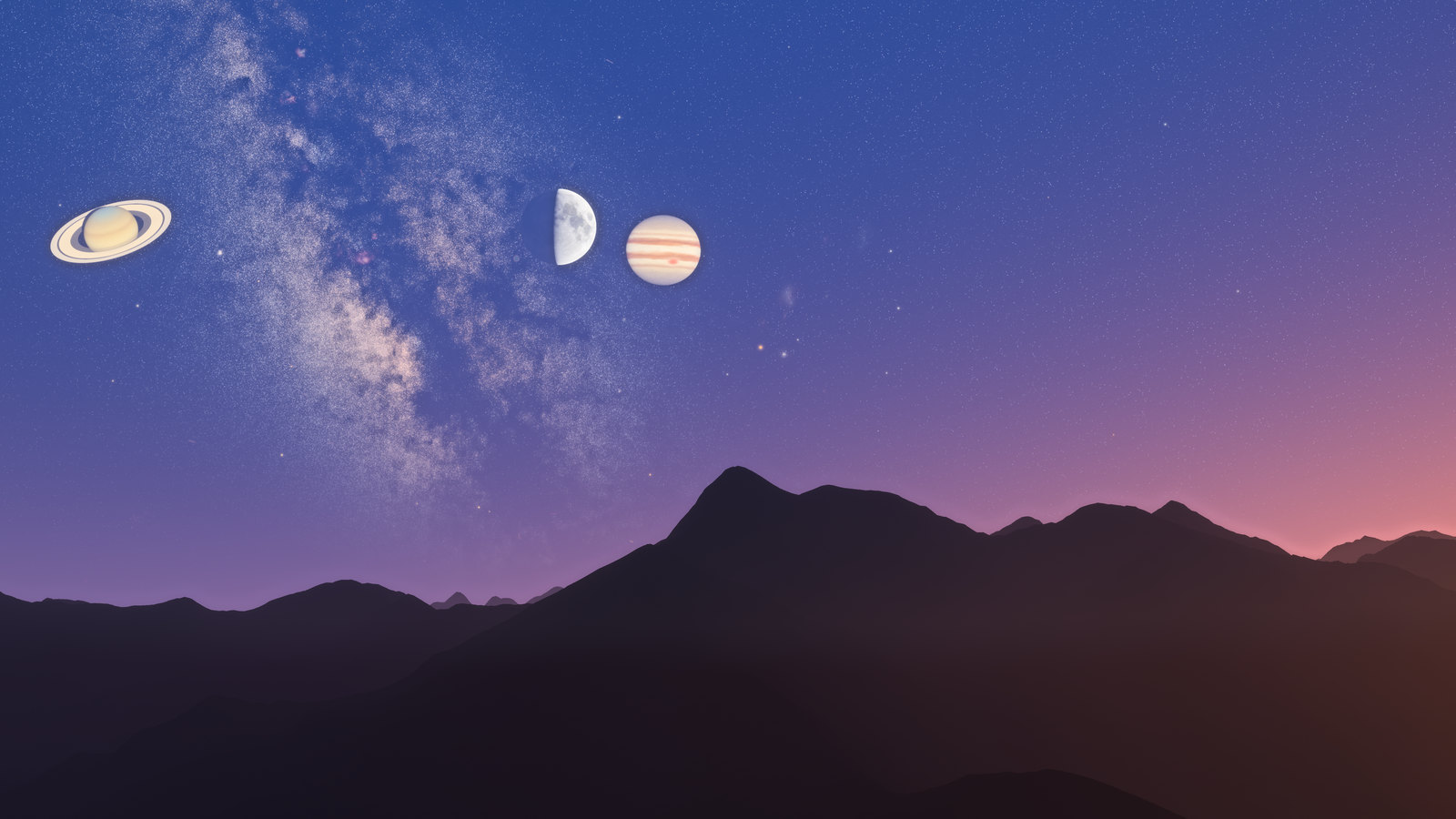
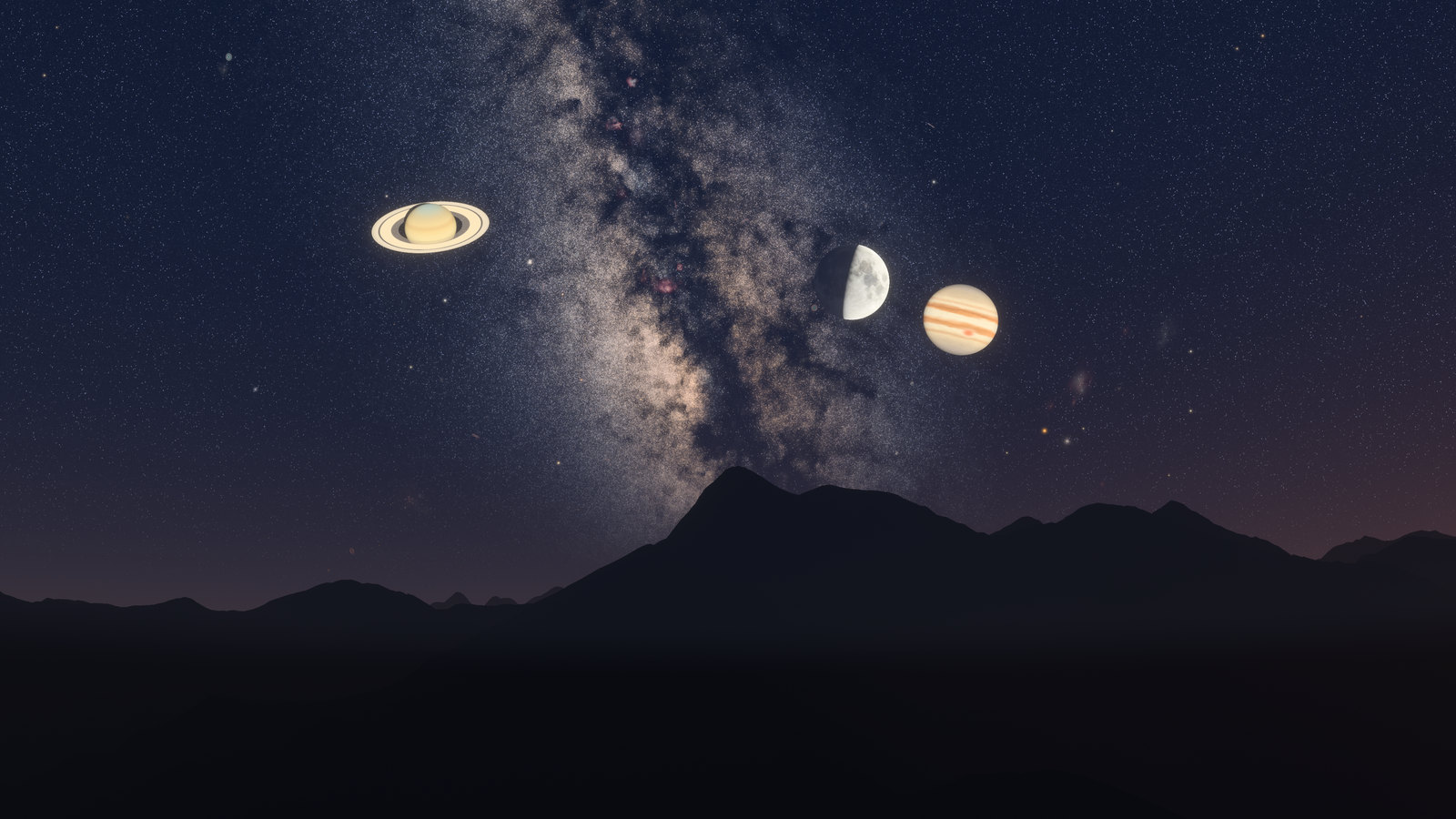
The night sky over the Hohe Tauern, seen from the Edelweißspitze: the Milky Way rises from a ridge, with Saturn to its left and the half-lit Moon and Jupiter to its right.

The sky, exactly as it was.

Edelweißspitze, Austria47.1236° N12.8311° E

Friday6 September 2019

Positions true to the sky. Moon, planets and nebulae enlarged.

Every sky happens once.

The stars come round again each year. The Moon and the planets among them never stand the same way twice. We compute the sky that stood over your place at your minute, and make it an artwork.

You tell us three things.

Place
Anywhere on Earth: a city, a village, a summit.
Moment
A date and a time, to the minute. Any day from 1900 to 2050.
Words
Names, or a line of your own, set beneath the sky.

From these we work out where the Moon, the planets and every star you could have seen stood above you. We draw the Milky Way behind them and raise the real skyline of your place in front.

An artwork, a record, a gift.

The sky over the Edelweißspitze on 6 September 2019 at 21:00 as a print, with its caption beneath the skyline.
To scale, above a sideboard 160 cm wide.

Framed

Your sky as a fine-art print in a frame, ready to hang. Nothing is on the front but the sky and your words. Our mark is on the back.

Shape
Size
Frame
On the front
Paper
Hahnemühle Photo Rag, 308 gsm
With it
The Almanac of your sky, numbered

from €109

Create yours

The sky over the Edelweißspitze on 6 September 2019 at 21:00 as a print, with its caption beneath the skyline.

Print

The same print without a frame, for the frame you already have in mind. Portrait or landscape, with the horizon of your place along the foot, or the whole sky in one circle.

Shape
On the front
Sizes
30 × 40, 50 × 70 or 60 × 90 cm
Paper
Hahnemühle Photo Rag, 308 gsm
Print
Giclée, the fine-art inkjet process
With it
The Almanac of your sky, numbered

from €79

Create yours

The same sky as a desktop wallpaper.
The same sky as a phone wallpaper.

Digital

Your sky as wallpapers, each one framed for its screen. With your words beneath the sky, or the sky alone.

Caption
For
Phone, tablet and desktop
Desktop
3840 × 2160 pixels
Phone
1290 × 2796 pixels

from €19

Create yours

Look again.

Everything is where it was. Point at a light to read what it is.

Names on the sky
SagittariusScorpiusLibraOphiuchusCorona AustrinaScutumSerpens CaudaRho Ophiuchi NebulaLagoon NebulaEagle NebulaM4Trifid NebulaAntaresKaus AustralisNunkiDschubbaSabikMoonSaturnJupiterAquilaScorpiusOphiuchusCorona AustrinaSagittaScutumSerpens CaudaLagoon NebulaEagle NebulaM4Trifid NebulaAntaresKaus AustralisNunkiRasalhagueSabikMoonSaturnJupiter

21:00 over the Edelweißspitze

  • 13.8° the Sun below the horizon
  • 2,267 stars above the horizon bright enough for the naked eye
  • waxing gibbous Moon

The Almanac

An almanac is a table of the sky for given dates. Ours is for a single minute: yours.

It lists each body that stood above you, how high and in which direction, how far away it was, and how long its light had been on the way.

It comes with every print as a card, numbered. If you like, we also print it on the front, beneath the sky.

The light of Vega in this sky set out in 1994.

No. 000137

Almanac

Edelweißspitze, Hohe Tauern, Austria

47.1236° N 12.8311° E, 2571 m
Friday 6 September 2019, 21:00 CEST (19:00 UTC)

Sun and Moon

Sun13.8° below the horizon: astronomical twilight
Moon57% lit, waxing gibbous. 18.1° high in the SSW, 386,706 km away. Its light took 1.29 s.

Planets above the horizon

PlanetAltitudeDirectionMillion kmLight took
Jupiter15.8°SSW 208°76943 min
Saturn20.4°S 178°1,42179 min
Neptune11.9°ESE 112°4,328241 min

Below the horizon: Mercury, Venus, Mars, Uranus.

Bright stars

StarAltitudeDirectionLight-yearsLight left
Arcturus27.9°W 268°36.71982
Vega81.2°SSW 201°25.31994
Capella5.6°NNE 16°42.21977
Altair49.9°SSE 157°16.82002
Antares9.7°SSW 212°c. 600c. 1400
Alioth37.5°NW 315°c. 81c. 1939

Also in this sky

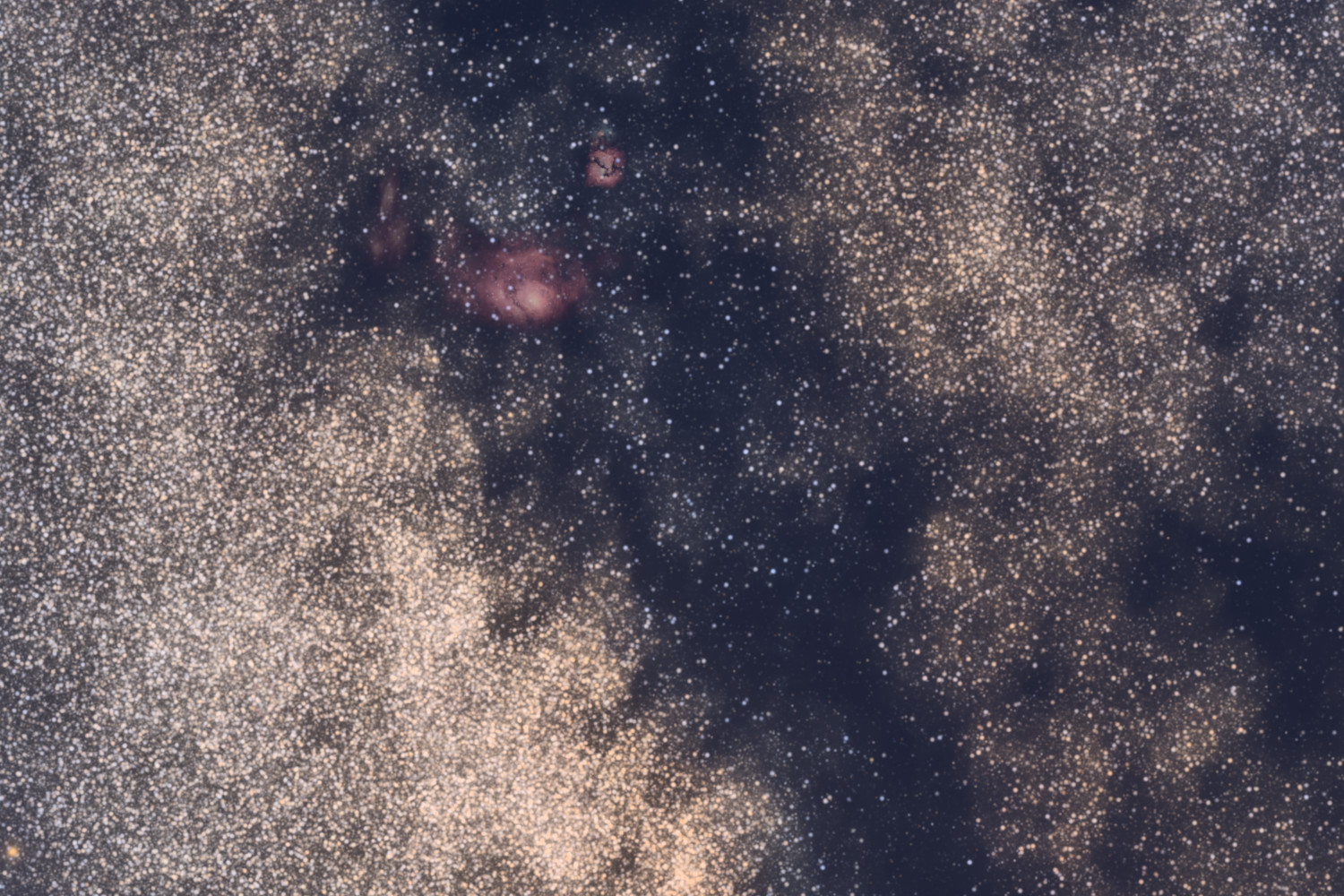
2,267 stars of magnitude 6 or brighter stood above the horizon: those a naked eye can see under a dark sky. The picture shows 55 nebulae, star clusters and galaxies, among them the Lagoon Nebula, the Eagle Nebula and the Trifid Nebula. The centre of the Milky Way, 26,700 light-years away, stood 12.5° high in the SSW.

Positions: NASA JPL DE421. Stars: ESA Hipparcos and Tycho. Terrain: Copernicus DEM.
Christopher Granabetter, astrophysicist, Vienna
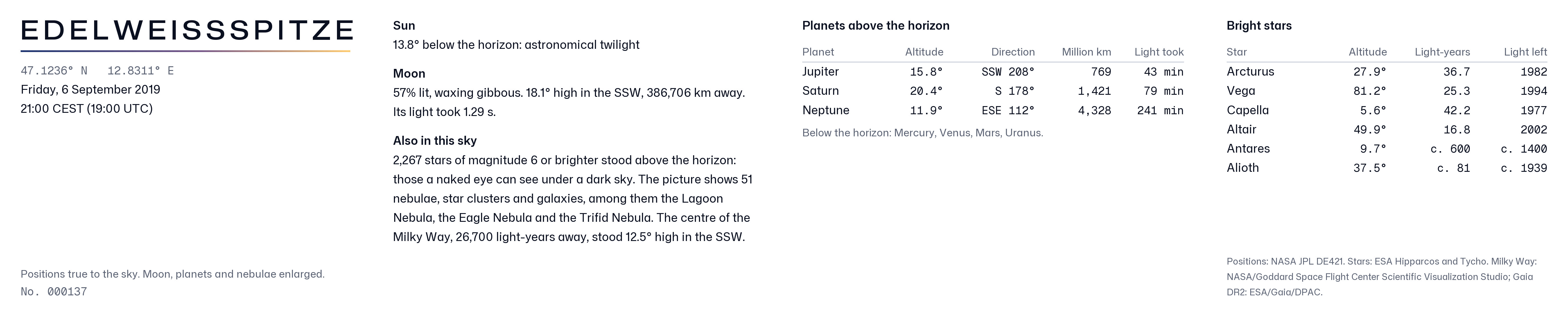
The Almanac as it prints on the front of a 50 × 70 cm print. Open it at full size.

Made to be looked at closely.

A 50 × 70 cm print holds 5906 × 8268 pixels. These three pieces are cut from it. Open one to see it pixel for pixel.

5 cm on the print
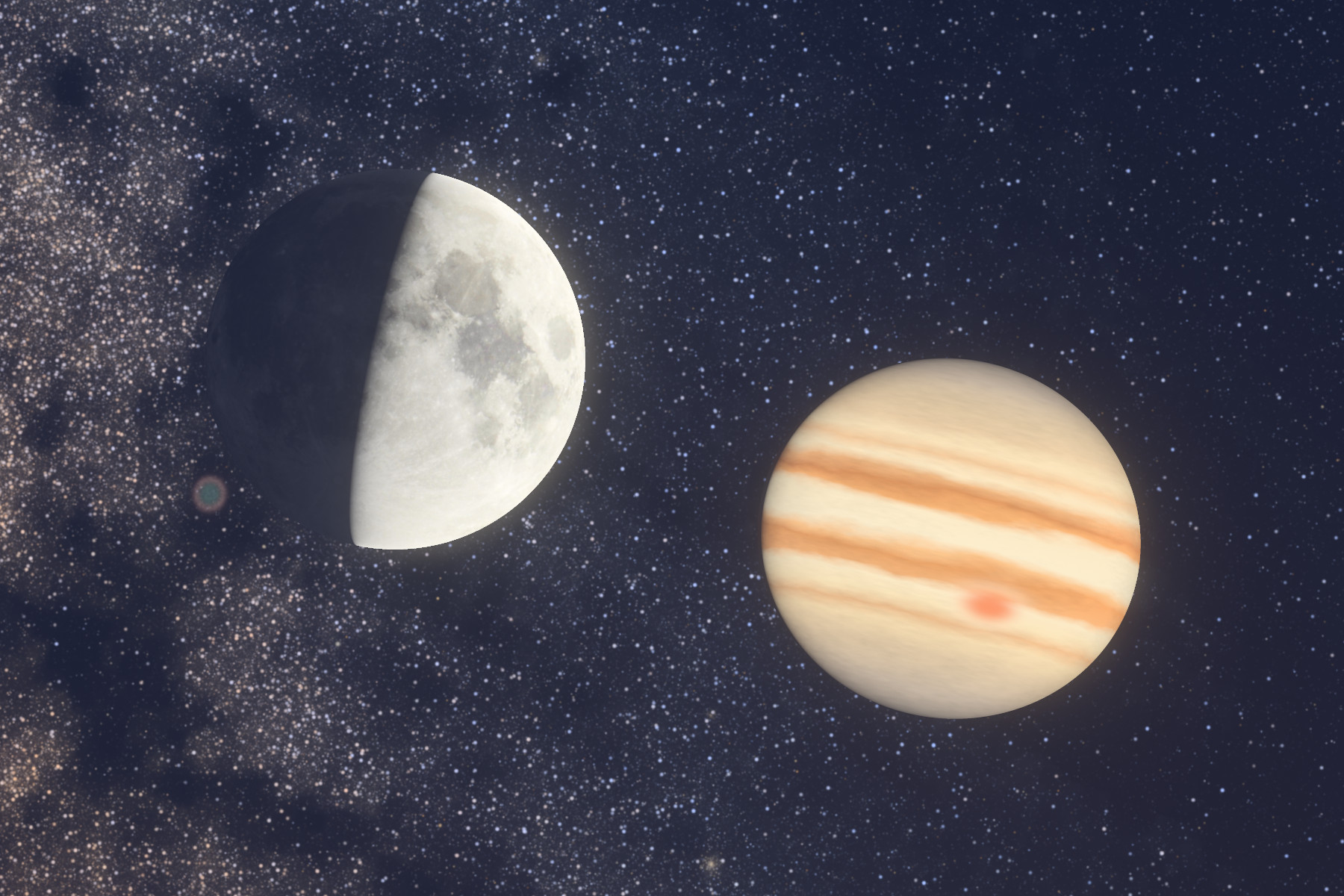
The Moon, 57% lit, and Jupiter. That evening the Moon was 386,706 km away, Jupiter 769 million.
5 cm on the print
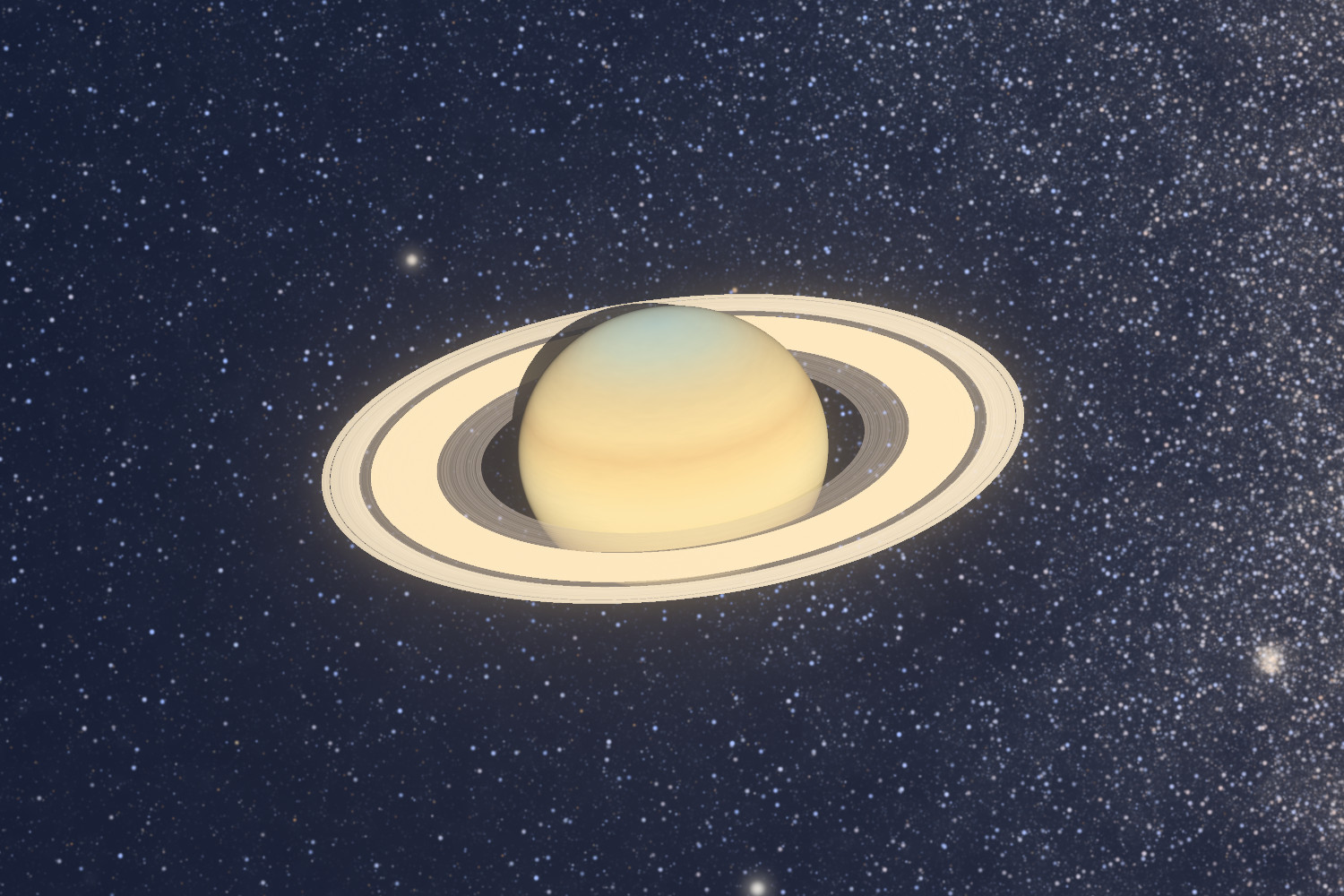
Saturn, its rings tilted 25° towards us. Its light had been on the way for 79 minutes.
5 cm on the print
The Lagoon and the Trifid Nebula among the star clouds towards the centre of our galaxy.

Six layers, one sky.

Each artwork is built in layers, from the galaxy to the ground, then graded like an astrophotograph.

Build the sky up to

What we never change

Where things are. The Moon, the planets, every star you can see with the naked eye and every catalogued nebula and galaxy stand at their true positions. We never invent an event.

What we change, and say so

How large things appear. To the eye the Moon is half a degree wide and a planet is a point of light. We draw them larger, so you can see the phase of the Moon and the rings of Saturn. The caption says so. Ask for the true sky and everything keeps its real size.

The data behind every layer, and who made it

Dusk, night, dawn.

Three other minutes, each as it was.

Innsbruck23 May 2023, 21:25

The Moon, four days old, beside Venus in the last light. Mars stands above them.

Vienna1 January 2000, 00:00

Orion and Sirius over the first minute of the year 2000.

Glacier Point24 June 2022, 04:50

Venus, the Moon, Mars and Jupiter in a line beside Half Dome, before sunrise.

The whole sky.

Every star above you at that minute, in one circle around the zenith. The skyline of your place is its rim; north, east, south and west stand around it.

The whole sky over the Edelweißspitze at 21:00 on 6 September 2019, as one circle with the compass points around it and the caption beneath.
The same sky on a landscape sheet, the circle on the left and the caption beside it.

Upright or on its side, as a print, framed, or as wallpaper for your phone, tablet and desktop. You choose which direction stands at the top.

Create your full sky

Editions

Some nights belong to everyone. We have computed them already, as numbered editions that are ready to ship.

The first stepHouston, 20 July 1969, 21:56

Neil Armstrong steps onto the Moon. Over Houston it stands 23° high in the west-south-west, 35% lit and 385,583 km away.

Mars at its closestVienna, 27 August 2003, 01:00

Mars is 55.8 million km away, closer than it has been in almost 60,000 years. It stands 26° high in the south.

Seven planetsVienna, 28 February 2025, 18:10

Seven planets stand above the horizon at once. From west to east: Mars, Saturn, Mercury, Venus, Neptune, Uranus and Jupiter.

Each comes as a print or framed, with the Almanac of its night.

From the founder

I am an astrophysicist in Vienna, and I photograph the night sky myself.

I built Cosmoment to make a thoughtful gift: an artwork that brings the universe closer and shows the person who receives it what they mean, on the scale of the universe. It had to be an artwork and a true record of the sky at once.

So every artwork is computed from the data astronomers work with, and I check what the engine draws against my own photographs of the sky.

Christopher Granabetter

Questions

Is this the real sky?

Yes. The positions of the Sun, the Moon and the planets come from NASA JPL's ephemeris, the stars from measured catalogues, and the skyline from an elevation model of the Earth. We compute all of it for your place and your minute.

Why are the Moon and the planets so large?

So that you can see them. In the sky the Moon is half a degree wide, and Saturn's rings need a telescope. We draw the Moon, the planets and the nebulae larger than life and leave them exactly where they stood. The caption on every print says so, and you can ask for the true sky instead.

What if my moment was in daylight, or under clouds?

The stars were there all the same. We show the sky as it stood above the weather. A moment in daylight is shown as day. If you would rather see the stars of that minute, ask for the night view.

Which places and dates can you do?

Any place on Earth, and any minute from 1900 to 2050.

Can I send it back?

A personal artwork is made for you alone, so it cannot be returned unless something is wrong with it. An edition can be returned within 14 days. The terms have the details.

Where does the data come from?

From NASA, ESA, the Copernicus programme and the people who keep the catalogues. Every source is named on the credits page. Cosmoment is not endorsed by NASA, ESA or any data provider.

You mean the universe to me.

Create your sky

Enter the date, the time and the place. Turn the sky to the view you want, add your words, and choose how it should reach you.

Create your sky